Sunday, April 8, 2007

Dead Among the Living?

But on the first day of the week, at early dawn, they came to the tomb, taking the spices that they had prepared. They found the stone rolled away from the tomb, but when they went in, they did not find the body. While they were perplexed about this, suddenly two men in dazzling clothes stood beside them. The women were terrified and bowed their faces to the ground, but the men said to them, "Why do you look for the living among the dead? He is not here, but has risen.”
Luke 24: 1-5

Easter has always seemed to me to be the Christian High Holy Day. In a culture determined to leave no stone unsold, Easter has stubbornly resisted the commercial chains that bind Yuletide like Marley’s ghost. Bunnies, chocolate, a fancy hat here and there – pretty tame stuff when compared to Halloween, let alone Christmas.

So I have always felt Easter is a day to be taken seriously. Pope Gregory may have balanced time on the fulcrum of the nativity, but in my mind, history didn’t really turn the corner until the morning Luke describes in his gospel.

Everybody knows the story. It’s early morning. The handful of Jesus’ disciples who cannot hide their identities are hiding their faces. A small party of women makes its way to the Garden to complete Jesus’ burial preparations after his hasty entombment before the Sabbath. The last thing anyone expects is to find the door open and the chamber empty.

Each gospel tells the next part in a little different way. An angel appears. A mysterious gardener speaks. For Luke, it is this pair of men in dazzling clothes. Different renderings, but one common thread – no one on that Sunday morning, not even the people who loved him best, expected to find Jesus anywhere other than in that stone hole in the earth. No one knew Jesus better than they. These men and women had walked with Jesus, fished with him, eaten with him, and slept by his side under the desert stars. They accompanied his triumphant entry into Jerusalem and his agonized last steps to Golgotha.

If anyone on earth could make such a claim, these people were the experts. They knew what Jesus was all about and they knew exactly where to find him.

And the experts were wrong.

Why do you look for the living among the dead?”

A person would have to be crazy to do such a thing. Yet that is just what we do when we seek Christ. We read books. We sing songs. We go to lectures and sermons where experts quote other experts. We pray old prayers. We kneel in old buildings. We run through the maze of 2000 years of traditions, rolling away stones, looking for the secret place where the body of Christ is hidden.

He is not here, but has risen.


In John’s Easter story, Jesus warns Mary, “Do not hold on to me,” yet the church clings to the Jesus we think we know, even as the living Christ rolls away the stone door of our imagination and walks out to do his work in the world. We are like a child who runs with a fist full of sugar, only to find his palm sticky and empty when he finally opens it again.

We seek the living Jesus among the dead when we cling to our opinions as if they were God's truth.

We seek the living among the dead when church is the only place where we “feel close to God.”

We seek the living among the dead when we pass up the chance to visit a sick friend so we can rush home to pray for her.

The living Christ will not stay in the cool white tomb where we can roll away the stone when we want a little visit with Jesus. He is not there.

Christ is alive and well. He is weeping with the wife who can’t stop drinking and the husband who can’t stop cheating. He starves with the refugee and shivers with the homeless. He wakes sweating in fear next to the prisoner on death row. He bends his knee to scrub public bathrooms. He knocks at my door, or comes to me on the street, begging for the money that I refuse because I know it will only go to buy more beer. He lives with the sex offender down the street who dares not answer his door for fear of being evicted again. He stays awake with the child who dreads the creaking of floorboards and footsteps in the night. Jesus is comforting the dying. He is strengthening the weary. He is giving hope to the hopeless in every home, workplace, village, and web site on earth.

And yet I go looking for him in tradition and nostalgia.

He is not here, but has risen.

There is a lot to be said for Easter Tradition. Grandma in her lavender dress. Grampa getting up early to shine his church shoes. Mom helping us to dye eggs. Dad teaching me to tie my tie. But our memories – good or bad – are not alive. They are the dead skin life sheds like a snake in the sun. They give us comfort by reminding us of what once was, but they cannot replace the challenge of living with what is. Too often we look at life like those confused women staring dumbly into an empty tomb, searching for the living God who has better things to do than stay dead.

The long darkness of Lent is past. The light of the Easter Season is upon us. God forbid we should lose the one by clinging to the other. God grant us the courage to open our hands to share the sweetness of the love we have received so freely.

God bless the church and all creation on this Holy Feast of the Resurrection of our Lord.

Alleluia!
Amen!

Saturday, April 7, 2007

The Second Day


Lift up your heads, O gates!
and be lifted up, O ancient doors!
that the King of glory may come in.

Psalm 24:7

Holy Saturday may be the strangest day of the church year.

It is invisible.

Thursday evening begins what is known in the liturgy as the Sacred Triduum - the holy three days. The feast begins with Maundy Thursday, followed by Good Friday, and concludes with the Great Vigil of Easter. Saturday is as quiet as the empty tomb. There is a brief liturgy for the morning, slipped in like an asterisk.

There is an ancient tradition about this day, but in our damnation-shy culture, we have soft pedaled it into silence. Mysterious reference is made to this tradition in the Apostle's Creed.
He was crucified, died and was buried. He descended into hell.
When I asked my parents about this unlikely phrase, they explained to me that in Greek, the word hades also meant a grave, so the creed was just affirming that Jesus spend a day in a tomb. This interpretation is so prevalent that in many parts of the contemporary church, the phrase has been altered to "He descended to the dead." He went where dead people go. He was buried.

John Calvin, who had no modern scruples about Hell interpreted the tradition another way. To him, Christ's descent into Hell was the spiritual completion of his fleshly passion. Jesus' redemptive suffering continued after his earthly death when his spirit, forsaken by the father, descended to experience the tortures of the damned in Hell. In Calvin's eyes, this made the price of redemption all the more precious and elevated Christ's sacrifice to a cosmic scale.

The apocryphal Gospel of Nicodemus (aka The Acts of Pilate) proposed another explanation - one that has been embraced by the church for centuries. The Gospel of Nicodemus records the testimony of three men raised from the dead who came to Jerusalem to bear witness:

We then were in Hades, with all who had fallen asleep since the beginning of the world. And at the hour of midnight there rose a light as if of the sun, and shone into these dark regions; and we were all lighted up, and saw each other. And straightway our father Abraham was united with the patriarchs and the prophets, and at the same time they were filled with joy, and said to each other: This light is from a great source of light. The prophet Hesaias, who was there present, said: This light is from the Father, and from the Son, and from the Holy Spirit; about whom I prophesied when yet alive, saying, The land of Zabulon, and the land of Nephthalim, the people that sat in darkness, have seen a great light.
This is not the Hades my father told me about. These souls were with the damned in Hell. With nothing but their own righteousness to commend them, they could not enter communion with God in Heaven. They had died without the redeeming blood of Christ.

Many artists have taken up this theme.Fra Angelico shows the Devil crushed under the broken down gates of Hell where Christ has flung them. Jesus' outstretched arm extends deliverance the the faithful dead. Traditionally Adam and John the Baptist are first in line.

Pieter Huys renders the "Harrowing of Hell" on a grand scale. In a graphic hell-scape reminiscent of Hieronymus Bosch, Huys pictures the light of Christ piercing the darkness of Hell where some are redeemed, some are past hope, and some tortured souls cannot bear to even look upon the savior as he approaches.

Some of my favorite interpretations of the "Harrowing" tradition are those of the great German engraver, Albrecht Durer. One is startled by their intimacy. Here it is the demons who are tortured by Christ's holy presence. The redeemed stand triumphant, pulled from the mouth of hell by a savior who is as much action hero as spiritual deliverer.
Durer's Christ bears the banner of a victorious warrior, reclaiming Hell's hostages to lead them home. Adam, Eve, and the Patriarchs have the look of people shocked by their own liberation, while the Baptist appears to be explaining who and what this man Jesus is, even as he did in life.

I find the etching dated 1512 to be the most beautiful of all. The violence of the destruction of Hell's gates is evident as they lie smoldering, consumed by Hell's own fire. Demons cower helplessly as Eve gazes lovingly at Adam, while the first man watches in amazement as the goat skin clad Baptist, his hands clenched in prayerful gratitude is lifted by his wrists out of the fire and into the light.

What happened on that silent Second Day? Certainly Jesus' body spent it in the hades of Joseph's tomb. It is difficult to argue with Calvin's interpretation. It is carefully reasoned and theologically unassailable.

Still, the "Harrowing" is the most firmly rooted in tradition. The image of Christ reaching his powerful arm and lifting the faithful out of the fires of Hell is inspiring for two reasons.

First, it satisfies our sense of Justice. It is unimaginable that God would allow good people to suffer forever because of their ignorance of Jesus redeeming death and resurrection. Second, it assures us that there is no depth to which we can sink that is beyond the saving grasp of Christ. Not even the gates of Hell can separate us from the God who loves us and longs for our redemption.

It is Holy Saturday - the invisible holy day. The Lenten fast is not yet complete. The resurrection is not yet accomplished.

But in the silence, God's saving work through Christ has already begun.

Thanks be to God.

Amen

Thursday, April 5, 2007

Silence is All


It is finished
The last word spoken
The last drop bled out

Jeers
Sobs
Now memories on that bloody hill

Filthy battle ground where
No matter the courage of the hero
The Victor
Is always
the
same

He amazed me
Giving me away
Like a favorite toy
She is yours/you are his
And the man
Barely more than a boy
Shamed me with his tears
Mine, so long dried out
Used up to water the roots of a promise
The once tender shoot
Broken and brown
Trodden into the mud and the spit and the sweat

Even the man/boy was empty now
Standing silently by
As they untangled the empty bag where my son had lived
From the thorny branch where the wind had blown him
Pierced him through
Held him fast

Everything had been arranged before hand
Bribes paid
Arrangements
The Man brought his people and they carried the husk
Empty
To a stranger's grave
Empty
Where they laid my boy
Troublesome
Beautiful
boy

The voice had said
Salvation
called me
blessed

Poor Joseph.
His eyes burned with courage and fear
that night
when he told me
He would stay

we crossed the world a hundred times
the four
Man Boy Woman Donkey
tiny boats thrown about
by the storms of kings

Nazareth
Bethlehem
Jerusalem
Egypt

always returning
but never home
never quite home again

lost him in the temple
lost
wandering the city like a madwoman
a boy?
Have I seen a boy?
Look around you woman.
Can you count all the boys in Jerusalem today?

found him
where he should have been
Where he loved to be

Joseph
silently working
hard tired hands aching
swollen
His great chest rising and falling in his sleep
then falling
and rising
no more

It is time,
I would tell him
A mother knows

I will know
He would answer

Now we both
know

They did their best,
but the filth remains

the blood
the soil
soaking through the linen
I can see his face
through the linen

why

why did you do

all

this

?

The boy/man touches my arm
time to put out the lamp
time to step out into the night air
if there is any
While they roll the stone into place
The only sound that ripples in the night
even the wind is
silent

then they go
eyes lowered
touch
nod
nothing left to say.

the man/boy waits
my new boy indulging his new mother
I am
so very
alone.

My heart is so full that it wants to scream
but silence

silence

silence

is all

I turn from the tomb
He offers his hand
I take it

should I believe?
or is he another man sent by God
to break my heart?

I want to hear the voice again.
My husband
My son
My angel

but no more voices
not for me
his words shot through me like an arrow
"It is finished"

so it is
no more songs from the handmaid of the lord
silence

silence

silence

is all

oh my beautiful child, my boy, my gentle gentle son
what would i give to hear your voice again
but he has forsaken
both of us

tonight the sword has pierced my heart

but death is not

merciful

to mothers

You have the silence of the tomb
the peace of the grave
the end of the pain

I am left alone
in the silence

the silence

the silence

Do This in Rememberance

Maundy Thursday

Therefore, my dear friends, flee from the worship of idols. I speak as to sensible people; judge for yourselves what I say. The cup of blessing that we bless, is it not a sharing in the blood of Christ? The bread that we break, is it not a sharing in the body of Christ? Because there is one bread, we who are many are one body, for we all partake of the one bread.

1 Corinthians 10: 14-17

Your body, broken for me?

It is too much, Lord. Too cruel. Too insane. I am not worth your suffering. Why not just let me go? Leave me to my fate and look after your faithful people, the ones who have not broken your heart with their stupidity and selfishness and arrogance and ingratitude? If this is what it takes to save my life, let me die. How could I live, knowing what it cost you?

And the Lord said…

“It is not for you to decide who is worthy and who is not. I have chosen whom I have chosen and paid what I have paid for my Father’s glory. What has been broken, has been broken in hate and fear. But what has been laid down on the altar was laid down in love and in hope. The Creator has offered a sacrifice to the creature – not to worship, but to teach you how to love the imperfect in yourself and in all my beloved children. In the breaking of the bread, remember that I was willingly broken for you. To bring you home.

Go and do likewise, in remembrance of me."

Most merciful God, as we begin this most holy of seasons, grant us the vision to see your broken heart at the center of the Eucharist. A heart broken by our own sin – but a heart you allowed us to break, so that we your children might enter and dwell in it forever.

Amen

Wednesday, April 4, 2007

The Judgment of this World


Wednesday of Holy week


‘Now my soul is troubled. And what should I say—“Father, save me from this hour”? No, it is for this reason that I have come to this hour. Father, glorify your name.’ Then a voice came from heaven, ‘I have glorified it, and I will glorify it again.’ The crowd standing there heard it and said that it was thunder. Others said, ‘An angel has spoken to him.’ Jesus answered, ‘This voice has come for your sake, not for mine. Now is the judgment of this world; now the ruler of this world will be driven out. And I, when I am lifted up from the earth, will draw all people to myself.’ He said this to indicate the kind of death he was to die. The crowd answered him, ‘We have heard from the law that the Messiah remains for ever. How can you say that the Son of Man must be lifted up? Who is this Son of Man?’ Jesus said to them, ‘The light is with you for a little longer. Walk while you have the light, so that the darkness may not overtake you. If you walk in the darkness, you do not know where you are going. While you have the light, believe in the light, so that you may become children of light.’

After Jesus had said this, he departed and hid from them.

John 12:27-36

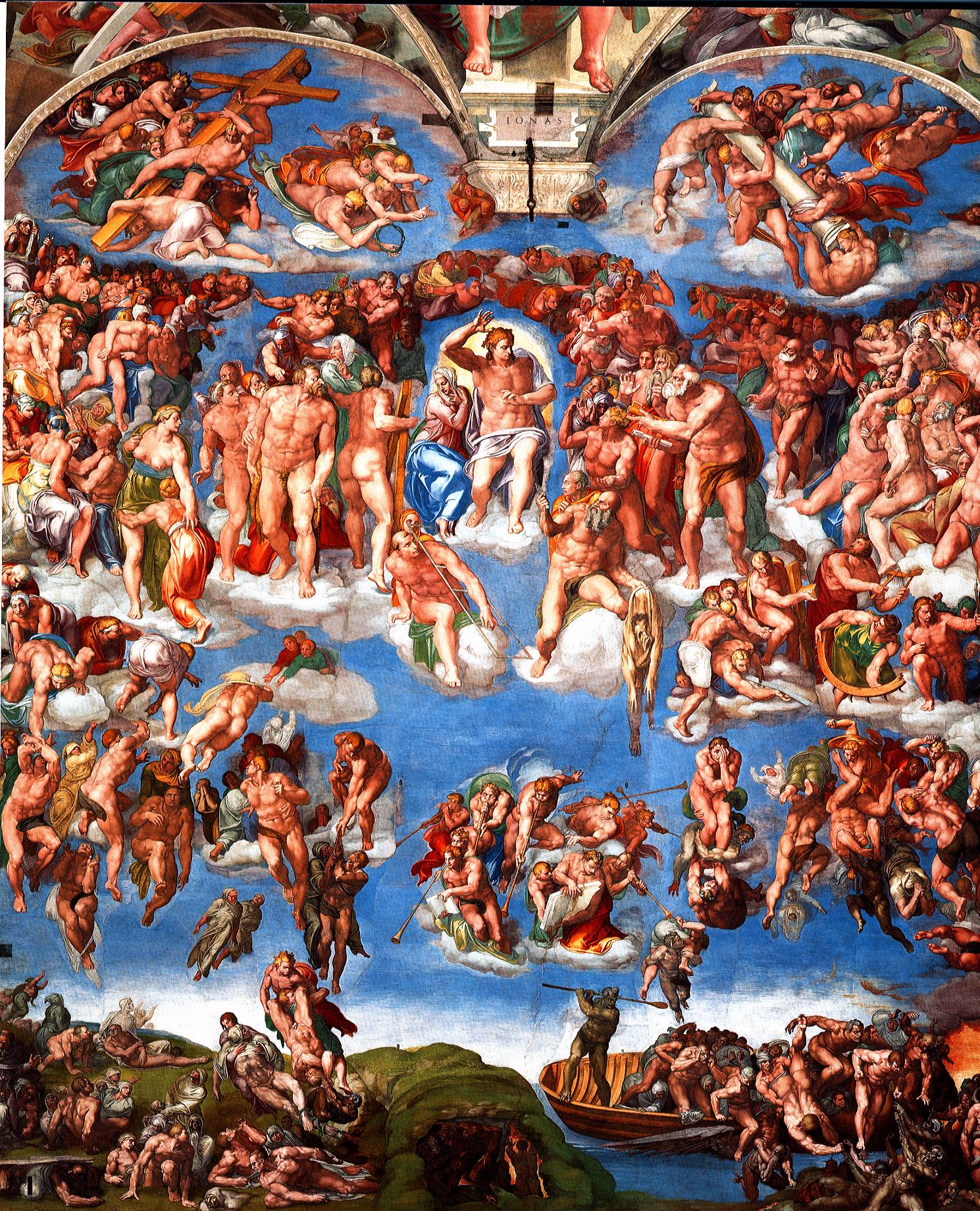
When we think of judgment we are used to thinking of images like the ones Michelangelo conjured – tortured souls filled with dread as they await the word that will cast them into the lake of fire. At the center of the terrible scene sits Christ, his mother at his side. One hand is raised over his head menacingly as he prepares to speak damnation. The other is held across his chest in an almost defensive posture. His body seems to recoil at the presence of those he is about to condemn as if he cannot bear them—or perhaps it is that he cannot bear to think of the fate they have chosen.

But there is a judgment that does not wait for the end of time. Our fallen world lives each day under judgment – not one that is proclaimed by Christ, but one that we choose for ourselves. Our gift of free will allows us to choose life. We are free to live as “children of the light.” As creatures made in the image of God, we have the capacity to point our will toward our creator.

There is another direction toward which we can orient our compass. We are also free to choose “the ruler of this world”. We are free to choose our own damnation by serving the creature rather than the creator. What did Jesus mean by the phrase “the ruler of this world?” Maybe he meant Caesar. He certainly ruled the world in which Jesus lived as much as anyone. Maybe he meant the Devil. Satan is often called the ruler of this world – the one who prowls like a lion looking for souls to devour. But I think the answer is much closer than that.

Humankind has been given dominion over creation. We have the freedom and the power to shape our world in ways Jesus could not have imagined in his father’s workshop. We are the ones who choose whom to serve, whom to deny, whom to love, whom to betray. We men and women are the rulers of this world, but only for a time. Our judgment is the accounting for our stewardship of the world with which we have been entrusted.

This judgment does not wait for Christ to burst through the clouds – it is a part of the fabric of creation itself. Humankind was created to live in Eden, but our world is no garden. We kill one another, starve one another, strangle whole nations with debts they can never pay, infect one another with diseases we can never cure. Our worship of ourselves – the rulers of this world – creates imbalance in creation. The universe itself is out of joint when the creature does not submit to the creator. Faced with so cosmic a calamity, no creature has the power to set things right again. Only the intervention of the one who spoke the cosmos into existence can do that.

And tomorrow, the church will remember the three days that gave the rulers of this world the chance to set things right again. We remember the night that the Word who was with God and who was God became flesh. We remember how he grew into a man, a friend, a teacher. We remember how he gave himself into the hands of the rulers of this world and how they tried to destroy him with whips and nails and vinegar.

And we remember how on the third day, Christ Jesus defeated even the grave, raised his hand and sent death itself into the fiery pit, snatching away its sting forever.

Our judgment is all around us. Everywhere we look in our broken world, we see evidence of a universe out of joint. Creation seems to be at war with itself.

In spite of all this, we have reason to hope. We need not choose damnation. We need not stumble in the darkness. Our God has given us the freedom to choose. We can believe that sound in the night to be thunder. We can call it the voice of a magical creature. Or we can recognize it for what it is – the echoes of the glory of God as the Holy Spirit sets about the long work of transforming and perfecting a creation that has lost its way.

Tomorrow, Maundy Thursday we will break bread in remembrance.

Tonight, may God grant that we remember why and for whose sake the “bread” was broken in the first place.

Amen

Saturday, March 31, 2007

Among the Olives

Tomorrow the church remembers Jesus’ strange procession into Jerusalem on the back of a colt. We call it Palm Sunday. We pass out long stringy fronds. We fold them into green crucifixes which will dry and turn brown in the heat of the summer. The scripture reminds us of a joyful time - a public affirmation of Jesus’ identity that infuriated what we used to call “the establishment”. Most strange of all perhaps, we remember Jesus words about stones with voices…

When Jesus had come near Bethphage and Bethany, at the place called the Mount of Olives, he sent two of the disciples, saying, "Go into the village ahead of you, and as you enter it you will find tied there a colt that has never been ridden. Untie it and bring it here. If anyone asks you, 'Why are you untying it?' just say this, 'The Lord needs it.'" So those who were sent departed and found it as he had told them. As they were untying the colt, its owners asked them, "Why are you untying the colt?" They said, "The Lord needs it." Then they brought it to Jesus; and after throwing their cloaks on the colt, they set Jesus on it. As he rode along, people kept spreading their cloaks on the road. As he was now approaching the path down from the Mount of Olives, the whole multitude of the disciples began to praise God joyfully with a loud voice for all the deeds of power that they had seen, saying,

"Blessed is the king
who comes in the name of the Lord!
Peace in heaven,
and glory in the highest heaven!"

Some of the Pharisees in the crowd said to him, "Teacher, order your disciples to stop." He answered, "I tell you, if these were silent, the stones would shout out."
Luke 19:29-40

Along with the triumph of Palm Sunday, our liturgy remembers the Great Tragedy that is to come. The hosannas of Palm Sunday are changed into the bitter recollections of Passion Sunday…

Jesus came out and went, as was his custom, to the Mount of Olives; and the disciples followed him. When he reached the place, he said to them, "Pray that you may not come into the time of trial." Then he withdrew from them about a stone's throw, knelt down, and prayed, "Father, if you are willing, remove this cup from me; yet, not my will but yours be done." When he got up from prayer, he came to the disciples and found them sleeping because of grief, and he said to them, "Why are you sleeping? Get up and pray that you may not come into the time of trial."

While he was still speaking, suddenly a crowd came, and the one called Judas, one of the twelve, was leading them. He approached Jesus to kiss him; but Jesus said to him, "Judas, is it with a kiss that you are betraying the Son of Man?" When those who were around him saw what was coming, they asked, "Lord, should we strike with the sword?" Then one of them struck the slave of the high priest and cut off his right ear. But Jesus said, "No more of this!" And he touched his ear and healed him. Then Jesus said to the chief priests, the officers of the temple police, and the elders who had come for him, "Have you come out with swords and clubs as if I were a bandit? When I was with you day after day in the temple, you did not lay hands on me. But this is your hour, and the power of darkness!"
Luke 22:39-53

“This is your hour.” Those are terrifying words. A few days before, the hour had belonged to Jesus, so much so that even the stones were prepared to cry out with joy. But the morning of Palms had become the night of the Passion. The hour now belonged to the people who hated Jesus and his radical ministry. In a few hours, the filthy, tortured savior of the world who was with God and who was God would utter a loud cry and breath his last to the sounds of laughter and mockery from many of the same strangers who had cried hosanna. Such is the protean nature of humankind. Such is the steadfast nature of our savior.

The week the church calls “Holy” is full of echoes. Every time I visit it, I hear new ones. This morning, I heard the echo of olives.

The olive tree has been celebrated and referenced in the cultural works of every society. Thomas Jefferson wrote: "The olive tree is surely the richest gift of Heaven". Aldous Huxley wrote: "…I like them all, but especially the olive. For what it symbolizes, first of all, peace with its leaves and joy with its golden oil." Federico Garcia Lorca wrote: "Angels with long braids and hearts of olive oil." Lawrence Durrell wrote in Prospero's Cell, "The entire Mediterranean seems to rise out of the sour, pungent taste of black olives between the teeth. A taste older than meat or wine, a taste as old as cold water. Only the sea itself seems as ancient a part of the region as the olive and its oil, that like no other products of nature, have shaped civilizations from remotest antiquity to the present."
The Olive Tree World


When Jesus needed courage, he went to the Mount of Olives to pray. He seemed to find both peace and strength in the company of their ancient healing branches. I am reminded of the Druids who found God in the oak trees of old Britain before the Christians came and “civilized” them. This is strange business - mystical trees, healing oil, leaves of victory and peace. It sounds a little magical, a little to Wiccan for our contemporary taste – as if Jesus were some sort of witch who looked for guidance in the mysterious powers of nature.

I’m not sure that is the lesson of Olivet, but there is no question that Jesus consecrated this ancient place with both his prayers and his blood. In a week of violence and pain, he found himself returning to a place where “the richest gift of Heaven” blossomed and bore fruit.

Deep within the madness of Holy Week, the trees of Olivet grow like a secret hiding place. We may not be able to travel to Gethsemane and walk the Via Dolorosa as Jesus did, but in our own solitude and contemplation, we can take a moment to seek God's will among the olives. Like Jesus, we can find strength in their limbs and peace in their shade. We can find healing in their oil. We can kneel on the consecrated ground where Christ knelt and give our fondest hopes and our greatest fears to God. Among the olives, there is comfort in knowing that an ancient and healing God is at work in our lives, continuing the sometimes painful work of creation and redemption, even in the midst of violence and betrayal.

Here amid the olives, as the terror of Friday morning approaches, as the terror of our own passion haunts us with fear and anxiety, we can taste the fruit of the olive and pray with Jesus…

Thy will be done.

May God grant us the courage to walk with Christ in the coming week, and all the days and nights of our lives.

Amen.

Sunday, March 25, 2007

Now and Not Yet


We live in a strange region of the kingdom of God – a region of Both/And - a region of Now and Not Yet.

Have you ever fallen asleep in the middle of the day, then awakened at twilight? You are in your clothes, on top of the covers. Your eyes are bleary. The windows are barely lit from outside. The clock reads 6:00 or 7:00. The house is quiet, and you have no idea if the world is going to sleep for the night or if you have just slept for fifteen hours and the dawn is about to break.

Our region of the Kingdom of God is like that twilight place. We are both awake and asleep. We live under both law and grace. We are both condemned and saved. We act with the fearful humility of convicted criminals and the joyful confidence of the children of the King.

Thus says the Lord, who makes a way in the sea, a path in the mighty waters, who brings out chariot and horse, army and warrior; they lie down, they cannot rise, they are extinguished, quenched like a wick: Do not remember the former things, or consider the things of old. I am about to do a new thing; now it springs forth, do you not perceive it? I will make a way in the wilderness and rivers in the desert. The wild animals will honor me: the jackals and the ostriches; for I give water in the wilderness, rivers in the desert, to give drink to my chosen people, the people whom I formed for myself so that they might declare my praise. (Isaiah 43: 16-21)

Like Pharaoh’s charioteers, we are doomed to fail. All our best efforts, our education and training, our genius and skills, our perseverance and our good works will allow us to achieve things that the world calls great, but they will not save us from the grave whose walls will close over us like the sea over the horses and riders of Egypt. No matter what honors we achieve in this live, all of us will ultimately be “quenched like a wick.”

The student of history will find countless reasons for despair. Why bother? What good will my striving do? Nothing changes. Nothing matters. We are tempted to lament with the author of Ecclesiastes, “All is vanity.”

But Isaiah tells us not to be deceived by the things we think we know about what is possible. “Do not remember the former things… I am about to do a new thing.” Even as we stand on a precipice at the edge of the valley of death, the prophet tells us that we are also at the threshold of the impossible. That dim window is not twilight, but daybreak. We have not awakened just in time to see the world sink into darkness, but we have been roused to witness the coming of God’s new day. Enemies will worship together. God will make safe paths through the dangers of our world. Healing waters will flow in the most broken desiccated heart.

When the Lord restored the fortunes of Zion, we were like those who dream.

Then our mouth was filled with laughter, and our tongue with shouts of joy; then it was said among the nations, “The Lord has done great things for them.”

The Lord has done great things for us, and we rejoiced.

Restore our fortunes, O Lord, like the watercourses in the Negeb.

May those who sow in tears reap with shouts of joy.

Those who go out weeping, bearing the seed for sowing, shall come home with shouts of joy, carrying their sheaves.


(Psalm 126)

The Psalm remembers the day the prophet promised – the day God delivered the children of Israel from captivity and they returned to the home that their grandparents remembered with tears by the waters of Babylon.

The people grieved for their lost homeland, but they did not despair – they did not give up faith in God. In spite of their tears, they still sowed hope. In Babylon, they were slaves, just as they had been in Egypt. All the glories of David and Solomon could not keep their ancestors from coming full circle back to chains and whips in a foreign land. But in spite of their circumstances, God’s people held fast to their faith in the covenant God made with Israel – “They will be my people, and I will be their God.” So they sowed hope – seeds of faith in the midst of captivity. They had failed to keep up their end of the bargain and had suffered the consequences of that failure, but God’s steadfast love had not failed. The tearful seeds of faith sown in Babylon produced the sheaves of joy that the former captives carried back to Zion.

…Even though I, too, have reason for confidence in the flesh. If anyone else has reason to be confident in the flesh, I have more: circumcised on the eighth day, a member of the people of Israel, of the tribe of Benjamin, a Hebrew born of Hebrews; as to the law, a Pharisee; as to zeal, a persecutor of the church; as to righteousness under the law, blameless. Yet whatever gains I had, these I have come to regard as loss because of Christ. More than that, I regard everything as loss because of the surpassing value of knowing Christ Jesus my Lord. For his sake I have suffered the loss of all things, and I regard them as rubbish, in order that I may gain Christ and be found in him, not having a righteousness of my own that comes from the law, but one that comes through faith in Christ, the righteousness from God based on faith. I want to know Christ and the power of his resurrection and the sharing of his sufferings by becoming like him in his death, if somehow I may attain the resurrection from the dead. Not that I have already obtained this or have already reached the goal; but I press on to make it my own, because Christ Jesus has made me his own. Beloved, I do not consider that I have made it my own; but this one thing I do: forgetting what lies behind and straining forward to what lies ahead, I press on toward the goal for the prize of the heavenly call of God in Christ Jesus. (Phillipians 3: 4-14)

No one understood the region of Now and Not Yet the way Paul did. In his letter to the Church at Phillipi he described his younger self as a man standing proudly on a mountain of his own virtues. His pedigree was flawless, his education elite, his behavior blameless. Then one day he looked down and saw that the mountain on which he stood was actually a pile of trash. Instead of a heroic vista overlooking God’s kingdom, Paul was standing in a dump, surrounded by rotting food and broken clay pots of his own making. Most of us would grieve to realize that all we had worked so hard to achieve in life was nothing but a pile of garbage, yet Paul considered it his great joy. He had encountered the living Christ face to face and been transformed into “a new thing.” He realized that nothing he had achieved by his own effort could compare to the prize he had received from God in Christ Jesus. Next to the promise of resurrection, and eternal life with God, Paul’s own achievements were worthless.

And yet…

And yet Paul did not stop “straining forward.” Blessed as he was by salvation, he did not consider it a reason for smug self-satisfaction. He did not wait passively for resurrection, he pressed toward it like a runner forcing herself past her threshold of endurance to sprint the last hundred yards of a marathon. Paul saw his life’s trophy case turned into a box of junk, and in response he ran even harder, not for his own glory, but for the glory of God. The Apostle from Tarsus had changed and also not changed. He was still the tireless over-achiever, the brilliant scholar, still the zealous messenger of God. But he was also the humble servant of Christ who had taken away all that he had, and in return, given him everything.

He began to tell the people this parable: “A man planted a vineyard, and leased it to tenants, and went to another country for a long time. When the season came, he sent a slave to the tenants in order that they might give him his share of the produce of the vineyard; but the tenants beat him and sent him away empty-handed. Next he sent another slave; that one also they beat and insulted and sent away empty-handed. And he sent still a third; this one also they wounded and threw out. Then the owner of the vineyard said, ‘What shall I do? I will send my beloved son; perhaps they will respect him.’ But when the tenants saw him, they discussed it among themselves and said, ‘This is the heir; let us kill him so that the inheritance may be ours.’ So they threw him out of the vineyard and killed him. What then will the owner of the vineyard do to them? He will come and destroy those tenants and give the vineyard to others.” When they heard this, they said, “Heaven forbid!” But he looked at them and said, “What then does this text mean: ‘The stone that the builders rejected has become the cornerstone’? Everyone who falls on that stone will be broken to pieces; and it will crush anyone on whom it falls.” When the scribes and chief priests realized that he had told this parable against them, they wanted to lay hands on him at that very hour, but they feared the people. (Luke 20:9-19)

The incarnation and ministry, death and resurrection of Jesus define this region of Both/And in which we live. We are the stewards of the vineyard, tending land that does not belong to us. All our achievements are because the creator of the vineyard has given us permission to be here. We owe the rightful owner everything, and yet paying our rent still chafes us. We look for loopholes in the lease. We ignore the letters and phone calls. We curse the bill collectors and send them away empty handed. In our own encounter with Christ, we meet the heir of the vineyard face to face, and we have a choice. We can welcome him as both our rightful master and our honored guest, or we can reject him – casting him out of our home as if we could make him disappear with harsh words and cast stones.

We are free to make that choice, but we are not free to choose the consequences. They will trip us up like a rock on the Damascus road and crush us like a boulder rolling down the mountain of our own achievements.

Life in the region of Now and Not Yet is not simple and it is not easy. We are tempted to choose one or the other – to deny what is to come in order to satisfy our enjoyment of what is now – or to deny what is before us in anticipation of what is to come. It is tempting, but it is not God’s will for us to live in either of these half-worlds.

The world of Now is the world where God’s work is done. Now is the place where children are raised, prisoners are visited, the hungry are fed, and the stranger is welcomed. Now is the place where each of us must run our race, straining for the goal like Paul did.

Not Yet is the world where God’s promise comes to completion. It is the place where we are given rest from our labors, and perhaps given new work to do – not creating rubbish, but treasures in the kingdom of Heaven.

The journey of Lent is coming to a close. In a few short days, we begin the week that the church calls Holy. It is tempting to succumb to despair as we retell and relive the journey from Palm Sunday to Golgatha. The journey is so tempting and so terrible that many are tempted to avoid it altogether. We wait for Easter morning, put on our lovely hats and our beautiful ties and parade off to church to celebrate the victory without acknowledging the battle.

Either choice denies the wholeness of who we are and who God would have us become. There is not one Key to the gates of the Kingdom, but two. One is the key of Now. The other is the key of Not Yet.

May the Holy Spirit grant us the courage and strength to hold them both as we build God’s Kingdom on earth as it is in Heaven – Both/And. Now and Not Yet.

Amen.